
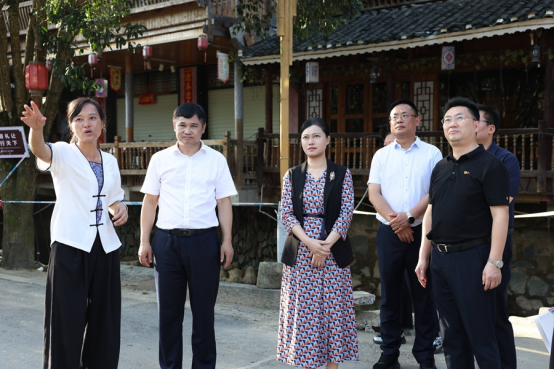
From July 10 to 11, Wei Zhaohui, secretary of the CPC Huaihua Municipal Committee, makes an investigation and research tour in Tongdao. The photo shows Wei Zhaohui personally inspecting the post-disaster recovery and reconstruction of the scenic area and the resumption of work by local residents. (Photo/Wu Tao)
From July 10 to 11, Wei Zhaohui, secretary of the CPC Huaihua Municipal Committee, made an investigation and research tour in Tongdao Dong Autonomous County, central China’s Hunan Province, and emphasized the need to thoroughly study and implement the important instructions given by General Secretary Xi Jinping on flood prevention and disaster relief, the guiding principles of the important speeches and the spirit of instructions of work related to Hunan, and call for more efforts in post-disaster recovery and reconstruction, and promote the improvement of the quality and rejuvenation of the cultural tourism industry. Municipal leader Hu Chen attended the tour .
During the heavy rainfall from June 20 to 21, Huangdu Village in Pingtan Township recorded a cumulative rainfall of 216 millimeters, affecting 304 households and 965 people. After making an on-site inspection tour of the post-disaster recovery and reconstruction of the scenic area and the resumption of work by local residents, Wei Zhaohui pointed out that the post-disaster recovery and reconstruction should be taken as an opportunity to promote the quality improvement and upgrading of the scenic area. He stressed the need to ensure solid work in the inspection and appraisal of housing safety, regulate and rectify overhead cables, fully support the resumption of work by the people, strive to reopen the scenic area as soon as possible, and minimize the losses suffered by the people due to the disaster. She also emphasized that river water levels should be scientifically managed and controlled through proper regulation and storage, that long-term mechanisms for flood control should be established and improved, and that strict precautions must be taken against the risk of abrupt alternation between drought and flood.
Arriving at the Wanfoshan Scenic Area, Wei Zhaohui carefully learned about the post-disaster recovery and reconstruction efforts and the development of the cultural tourism industry. She pointed out that it is of necessity to accelerate the progress of all post-disaster recovery and reconstruction, expedite the resolution of historical issues left over from nature reserves, thoroughly tap into the rare flora and fauna resources within the scenic area, meticulously plan the development of the scenic area, actively introduce social capital and strategic investors, cultivate local influencers in cultural tourism, continuously boost traffic and popularity in cultural tourism, and strive to build a world-class cultural tourism IP.
At the Hunan Dong Ethnic Museum, Wei Zhaohui thoroughly learned about the museum’s operation and management, the display and exhibition of Dong culture, and the achievements in the protection and utilization of covered bridges. She pointed out that it is necessary to deepen the market-oriented operation model, strengthen business format innovation, enhance digital and smart empowerment, revitalize idle museum resources, and improve its self-sustaining capacity to achieve sustainable development. It is also essential to deeply explore the spiritual core of Dong culture, enrich exhibition contents, innovate presentation forms, and solidly carry out the protection, inheritance, and display of Dong culture.
Arriving at the Tongdao Daji (or big open﹣air fair), Wei Zhaohui carefully learned about the intangible cultural heritage (ICH) cultural and creative products, as well as the inheritance and development of Dong brocade weaving techniques. She pointed out that the Dong brocade technique should seek innovation in the course of inheritance and pursue development through innovation, proactively adapting to market demands, ensuring that Dong brocade products keep pace with the times in terms of design concepts, material techniques, and application scenarios. It is also necessary to expand the local talent pool of ICH inheritors, broaden the production and sales channels for ICH products, and empower the long-term development of ICH culture.
(Translated by Yang Sigui)