
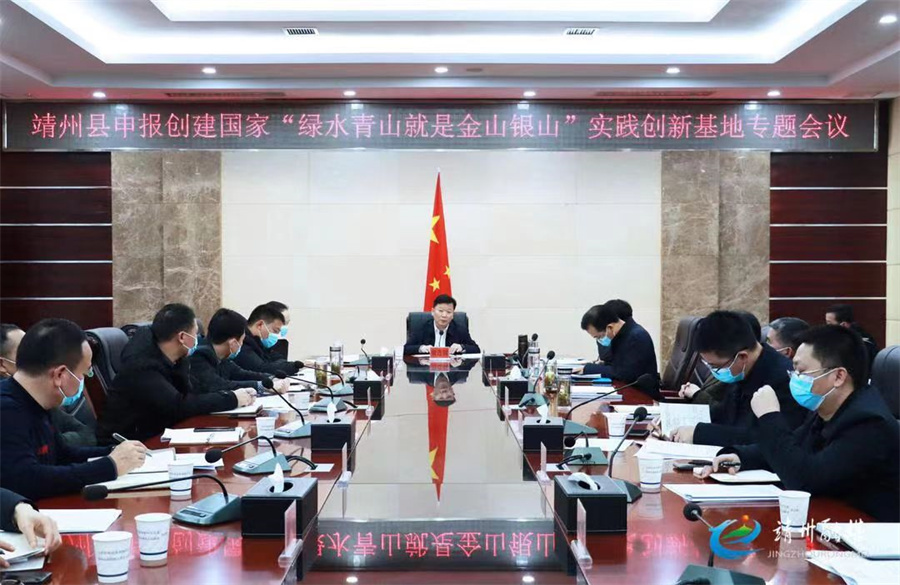
(Jingzhou County Party Committee holds a special session on the practice and innovation base—Lucid Waters and lush Mountains are Golden and Silvery Mountains.)
Green is a symbol of life and the most beautiful background of Jingzhou Miao and Dong Autonomous County. It is also the aspiration of the people for a better life.
The forest coverage rate is 74.93%, and the forest stock is 11.0353 million cubic meters. The per capita ownership ranks first in Hunan Province. In the midsummer season of Jingzhou, the mountains are lush, and the river is lucid. National Ecological Demonstration Zone, National Green and Well-off County, National Advanced Greening Collective, National Underforest Economic Demonstration Base, National “Lucid Waters and lush Mountains are Golden and Silvery Mountains” Practice and Innovation Base... Each of these “national” honors is a profound green accumulation in Jingzhou.
In recent years, Jingzhou has firmly established the concept that “Lucid waters and lush mountains are golden and silvery mountains”, vigorously practiced the “two mountains” concept, strictly implemented the decisions and deployments of the central, provincial, and municipal governments on ecological civilization construction, focused on strengthening ecological protection, building beautiful villages, developing green economy, and continuously relying on green to bring about fortunes, achieving the green rise of the transformation from beautiful scenery to a beautiful economy.
Defend the lucid waters and lush mountains in exchange for the golden and silvery mountains
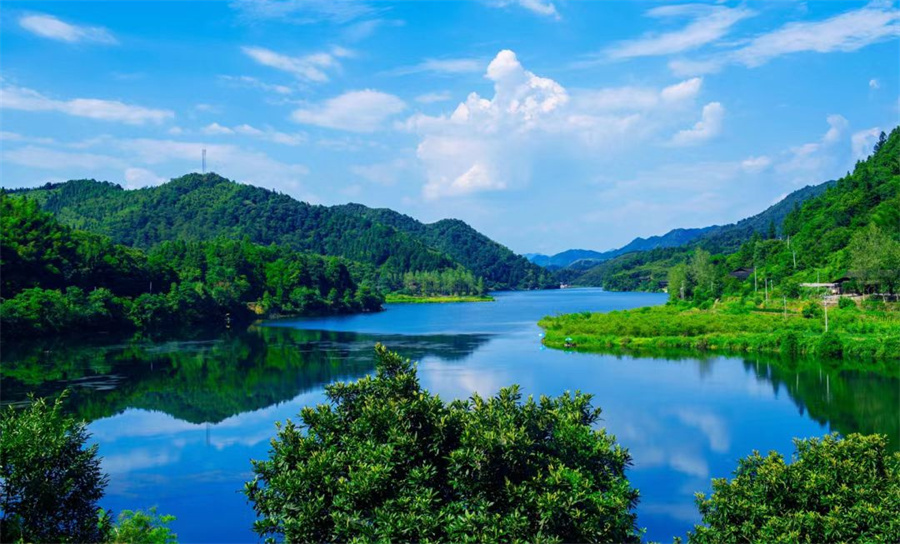
(Scenery of Qujiang River)
The lucid water gurgles with silvery light, and the lush mountains are stacked with gold belts. Ecology is a characteristic and development advantage of Jingzhou. How to take advantage of the lucid waters and lush mountains? Jingzhou has always adhered to the development concept of innovation, coordination, green, and openness, sharing in formulating its county economic development strategy. It has also adhered to the development strategy of “establishing an ecological county, promoting tourism, strengthening industry, and promoting commerce”, which requires both golden and silvery mountains, as well as lucid waters and lush mountains.
Since the introduction of the first local ecological and environmental protection regulation in Hunan Province, the Jingzhou Miao and Dong Autonomous County Ecological and Environmental Protection Regulation, a forest chief system intelligent management platform has been adopted throughout the province. 650 forest rangers and 286 forest chiefs at all levels in the county are under supervision. In 2022, the problem rectification rate and case investigation rate in the “Supreme Action” reached 100%, achieving a three-dimensional model of “satellite in the air, monitoring at the mountain top, and patrol under the forest” all-day monitoring mode.
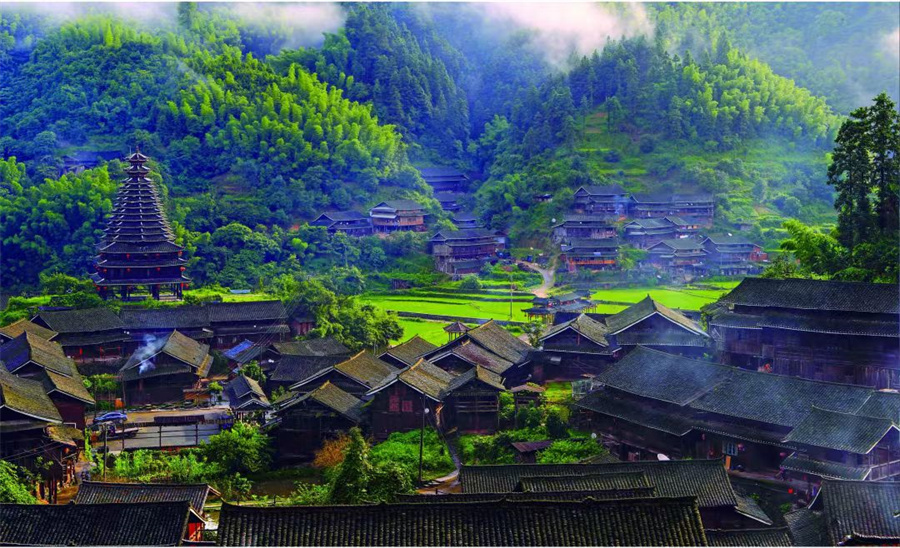
(Scenery of the Bamboo Shoot Miao Village)
In recent years, Jingzhou has polished its reputation as the “Hometown of Chinese red bayberry” and “Hometown of Chinese Poria Cocos”, and innovatively built a Poria Cocos Technology Industrial Park that integrates “processing, planting, scientific research, logistics, and research”. It has launched Traditional Chinese Medicine Base with “research and development in Jingzhou, transformation in enterprises, headquarters in the park, bases in towns, and scenic spots in the park”. It has also cultivated new formats such as ecotourism and health tourism, and promoted the launch of characteristic ethnic cultural boutique tourism projects led by ethnic villages such as local Bamboo Shoots Miao Villages and Yanjiao Dong Villages through the program “Where’s Dad Going”, thus achieving the “gilded signboard” of county-level ecotourism.
The total output value of the red bayberry and Hickory planting bases in the county is about 2 billion yuan, with a planting area of 70,300 acres of traditional Chinese medicine mainly focused on Poria cocos. The entire upstream, middle and downstream industrial chain has been developed, and the annual comprehensive output value of the entire industrial chain accounts for more than 30% of the county’s GDP... “The bayberry is red, Poria cocos is fresh, lush mountains are green, the industry is booming, and the people are smiling”, thus a beautiful picture of “ecological industrialization, industrial ecology” is unfolding.
Densely woven network for ecological environment governance
The most direct beneficiaries of implementing ecological environment governance are the general public. Jingzhou fully utilizes scattered plots and idle land to promote the construction of small amusement parks and micro green spaces, pays attention to balanced green space layout, and continuously improves park greening. Currently, 1,100 acres of provincial-level ecological corridors have been constructed, with a total of approximately 670,900 compulsory tree planting trees. The results of afforestation and greening space are among the best in the province. Pushing the window to see the green, going out and entering the garden has become a daily life for the people of Jingzhou.
The first week of June every year is the Jingzhou Soil and Water Conservation Ecological Environment Protection Week. Jingzhou fully utilizes various forms such as radio and television, outdoor electronic displays, promotional vehicles, bulletin boards, slogans, etc. to promote laws and regulations such as the Soil and Water Conservation Law, the Water Law, and the Environmental Protection Law to the public. 53,000 promotional manuals were distributed to the general public, forming a good atmosphere for the whole people to participate in and support soil and water conservation.
To carry out legislative work on the “Jingzhou Ecological and Environmental Protection Regulations” delineates ecological protection red lines and implements strict protection. Close protection will be implemented for the core and buffer zones of areas with an altitude of 800 meters or above, primitive secondary forest areas, primary drinking water source protection areas, and natural protection areas within the territory. Measures will be taken to seal off mountains and cultivate forests within 200 meters of the first ridge and flat land on both sides of highways, railways, national and provincial roads, as well as on both sides of the Qujiang River. Commercial logging of trees, mining and quarrying are prohibited, and a lifelong accountability system for ecological and environmental damage will be implemented.
It is a must to establish a Soil and Water Conservation Committee, establish a Soil and Water Conservation Bureau, establish soil and water conservation liaison officers and supervisors in townships and villages, implement the principle of territorial management and administrative head responsibility system for soil and water loss control and prevention supervision, and form a mechanism for soil and water loss prevention and control that is managed by the government, coordinated by multiple departments, and widely participated by the masses. In recent years, the reporting rate of soil and water conservation plans in the county has reached 97%, and the acceptance rate of soil and water conservation facilities in production and construction projects has reached 96%.
Build a Green Ecological Barrier
Green development has no limits. How to make lucid waters and lush mountains the new normal? Jingzhou has always focused on the requirements of ecological civilization construction in the new era. While strengthening protection, it adheres to the unit of small watersheds and implements comprehensive management of mountains, water, fields, forests, and roads.
Within the county, it is comprehensively prohibited to cultivate steep slopes above 25°, and the degree of slope farmland control reaches 65%. In recent years, Jingzhou has invested 48 million yuan to complete the comprehensive management of 12,500 mu of sloping farmland in 6 townships and 31 villages, including Gantang and Taiyangping areas, Feishan and Pukou areas, Hengjiangqiao, and Xinchang areas. The project area has added 3,164.7 acres of arable land.
It also requires to increase investment in water conservancy construction funds, complete the comprehensive treatment of 47 dangerous reservoirs and 4 small and medium-sized rivers, and solve the problem of drinking water for 153,900 people. Efficient and water-saving irrigation construction has been carried out in the Aoshang Red Bayberry Base and Hengjiang Qiaoshan Walnut Base, with more than 200 sets of drip irrigation equipment added and 12,100 acres of irrigation area improved.
It also needs to accelerate the construction of the five major projects of “clean homes, clean rural areas, clean water sources, clean energy, and wearing clothes and hats in Miao and Dong villages”. The county has built 11 large-scale harmless waste incinerators, 3,291 waste incinerators (ponds), 188 toxic and hazardous material recycling houses, purchased classified garbage bins and garbage trucks, and established a rural sanitation cleaning team. It has built 4 new sewage treatment plants and basically achieves the goal of developing clean aquaculture in 35 key villages, as well as dressing and wearing hats in 10 group villages such as Taiyangping, Genshankou, Aoshang, and Zhaiyaji Town.
The task of returning farmland to forests in the entire county is 109,500 acres, with 96.5 kilometers of “three sided” afforestation and greening. We will carry out comprehensive river regulation and ban 124 sand mining and suction vessels, as well as 65 sand lifting towers. Close more than 30 small coal mines, small mines, small brick factories, and small quarries within the county according to the law, and reduce pollution by 7 manufacturers. The monthly compliance rate of 252 drinking water sources in the entire county is 100%.
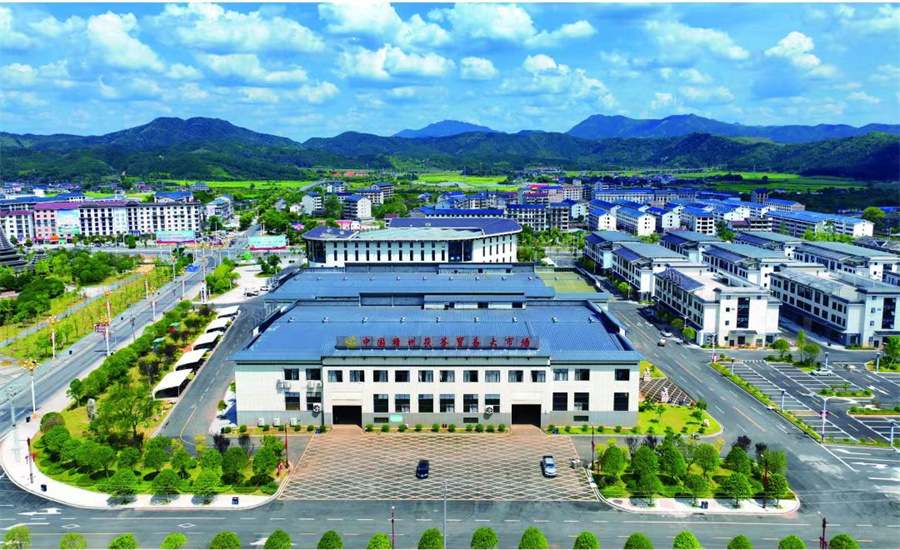
(Jingzhou Poria Cocos Trade Market)
With the solid progress of the ecological governance system engineering, Jingzhou has built a green ecological barrier. Nowadays, strolling along the ancient post roads of Dong Village in Miao Township and in the green shadows of the park is harmonious and joyful. Facing the future, Jingzhou will further promote the construction of ecological civilization in ethnic areas, allowing people of all ethnic groups in the county to enjoy ecological “dividends” and share green “welfare”.
(Translated by Tian Xia)