
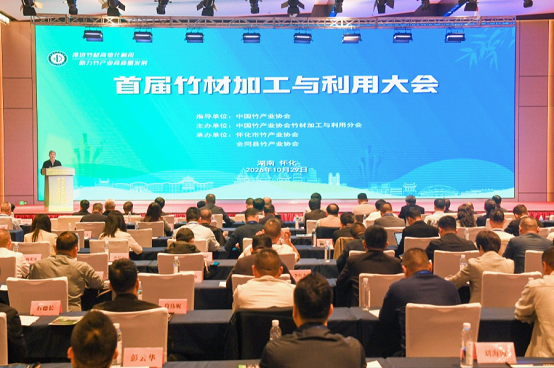
Huaihua holds the first Conference on Bamboo Processing and Utilization. (Photo by Yang Zhiwei)
The first Conference on Bamboo Processing and Utilization opened in Huaihua on the morning of Oct 29. Wei Zhaohui, secretary of the CPC Huaihua Municipal Committee, met with some of the experts attending the event. Gao Jingsheng, deputy secretary of the CPC Huaihua Municipal Committee and acting mayor of Huaihua City; Deng Shaohong, a second-level inspector with the Hunan Provincial Forestry Administration; and Chu Fuxiang, president of the China Bamboo Industry Association and a fellow of the International Academy of Wood Science, delivered remarks. Fan Guoqiang, a member of the Chinese Academy of Engineering and dean of the College of Forestry at Henan Agricultural University, and Fang Guigan, a fellow of the International Academy of Wood Science and chief scientist at the Chinese Academy of Forestry, delivered keynote speeches. He Weiying, vice mayor of Huaihua City, unveiled investment projects in the city’s bamboo industry.
In his remarks, Gao said that in recent years Huaihua had thoroughly implemented President Xi Jinping’s important instructions on developing the bamboo industry in light of local conditions, and had vigorously promoted bamboo as a substitute for plastic. The industry’s combined output value had doubled in two years, creating jobs and raising incomes for nearly 200,000 bamboo farmers. “This conference brings together leading bamboo-industry experts, cutting-edge technologies and innovative achievements from across the country, and will inject strong momentum into the high-quality development of the industry,” Gao said. “Huaihua will seize this opportunity to accelerate its development into a national base for manufacturing bamboo-based new materials and conducting export trade, contributing to national timber security and the green, low-carbon transition.” Gao invited experts and academicians to visit Huaihua and offer guidance, research institutions to establish platforms and put research results to use in the city, and bamboo companies to invest in projects and explore the market there. “We will provide the best possible services to ensure that you can invest with confidence, start businesses and grow comfortably,” he said.
Deng Shaohong said the Provincial Party Committee and the provincial government had consistently treated the bamboo industry as an important means of putting into practice the “Two Mountains Theory” and advancing all-around rural revitalization. Holding the conference in Huaihua was a valuable opportunity for Hunan, and he welcomed forestry departments, associations and businesses from other provinces to visit, exchange ideas and invest in the province. Hunan would use the establishment of a branch dedicated to bamboo processing and utilization as an opportunity to deepen cooperation with its partners in areas including joint platform development, technological research, standards-setting and the application of research results, Deng said. These efforts would help accelerate the high-quality development of Hunan’s bamboo industry.
Chu Fuxiang said Huaihua was accelerating its development into a regional hub bordering five provinces. The city has 1.6887 million mu (about 112,580 hectares) of bamboo forest and 310 million standing bamboo culms. It ranks fourth in Hunan in total bamboo resources and is one of China’s major moso bamboo-producing areas. In recent years, Huaihua has leveraged the opening-up advantages of the Huaihua International Land Port to create export channels for bamboo products, providing a practical example of innovative development for the national bamboo industry and laying a solid foundation for the conference, Chu said. He expressed hope that the event would help Huaihua build a national base for manufacturing bamboo-based new materials and conducting export trade, and become a model for the transformation and upgrading of China’s bamboo industry.
Drawing on their expertise and the current state of the industry, Fan Guoqiang and Fang Guigan discussed how tree breeding and bamboo pulping technologies should address the needs of frontline production and support upgrades across the whole industrial chain. Their keynote reports offered useful insights into technological innovation and the application of research results in bamboo processing and utilization.
The conference also saw the release of the White Paper on the Properties of Moso Bamboo in Huaihua, Hunan. Huitong county gave a presentation on its bamboo industry. Experts, scholars, business representatives, industry associations and officials from relevant government departments of 12 provinces attended the event.
(Translated by Yang Hong)