
Leverage local resources and targeted breakthroughs to strengthen and scale up the sector
He Zunqing attends the meeting
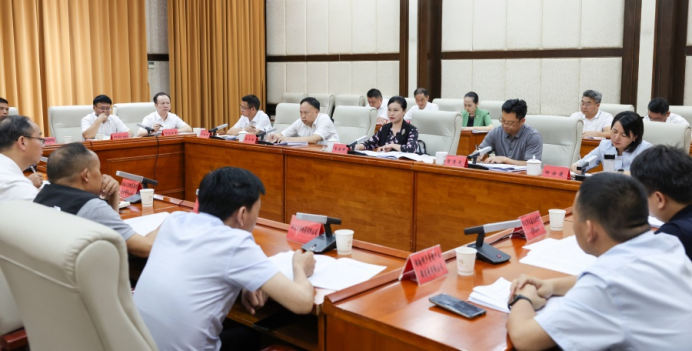
On the afternoon of July 14, Party Secretary Wei chaired a symposium on building the traditional Chinese medicine industry chain. Photo by Wu Tao, Huaihua Daily All-Media Reporter.
On the afternoon of July 14, Party secretary Wei Zhaohui chaired a symposium on advancing the development of the traditional Chinese medicine (TCM) industry chain. During the meeting, he emphasized the need to thoroughly study and implement General Secretary Xi Jinping's important remarks on TCM work, fully carry out the directives and requirements of the provincial party committee and provincial government, leverage local resource endowments, focus on key breakthroughs, accelerate the construction of the "Southern Chinese Medicine Valley," and make all-out efforts to strengthen, expand, and optimize the TCM industry. He Zunqing, deputy Party secretary and head of the Political and Legal Affairs Commission, along with municipal leaders Li Weilin and Xiang Rulian, attended the symposium.
At the meeting, an update was given on the progress of building the traditional Chinese medicine (TCM) industry chain. Representatives from ten enterprises — including Hunan Zhengqing Pharmaceutical, Hunan Huairen Group, Butian Group, Jingzhou Guoling, Huaihua Zhenghao, Hunan Wuxi Pharmaceutical, Hunan Dongxiang Polygonatum, Xinxi Peilin Borneol, Huaihua Zhongxin Agriculture, and Huaihua Haiwang — delivered speeches covering topics such as the current state of industry development, pharmaceutical research and development, challenges faced, and suggestions for extending, strengthening, and completing the industrial chain.
Wei noted that traditional Chinese medicine (TCM) is a gem of Chinese civilization, a vital pillar for building a “Healthy China,” and a strategic sunrise industry as well as a wealth-generating sector for promoting all-around rural revitalization and high-quality development in our city. In recent years, the Huaihua Municipal Party Committee and the Huaihua Municipal Government have attached great importance to the TCM sector, driving sustained growth in scale, continuous extension of the industry chain, accelerated brand building, and steady improvement in economic returns. However, he cautioned that the industry still faces notable weaknesses, including an incomplete industrial chain, insufficient leadership from leading enterprises, limited capacity for scientific and technological innovation, inadequate brand influence, and shallow integration across sectors. He stressed the need for targeted measures and step-by-step breakthroughs to elevate the development of the TCM industry to a new level.
Wei stressed the need to focus on five key areas:
First, strengthen the foundation.
Efforts should be made to improve seed and seedling breeding, promote standardized and regulated planting, and establish a number of improved variety breeding bases, ecological planting demonstration bases, and designated medicinal herb gardens. This will ensure the quality of medicinal materials at the source, enhance the quality traceability system, and consolidate the "first workshop" of the industrial chain.
Second, address weaknesses.
Steps should be taken to support local enterprises in upgrading from small to above-designated-size and foster the tiered growth of listed companies. Targeted investment attraction efforts should be directed at top 100 industry players and leading enterprises. The deep processing of Chinese medicinal materials should be vigorously developed, and shared production lines should be made available to startups. Processing enterprises should be encouraged to cluster and collaborate, thereby raising the value-added capacity of the industrial chain.
Third, stimulate vitality.
Platforms for scientific and technological innovation should be established, leveraging platforms such as the Academician Liu Liang Workstation. Joint efforts with institutions like Hunan University of Medicine and Central South University's Xiangya School of Medicine should be intensified to tackle core technologies. Local talent cultivation should be strengthened, school-enterprise collaboration deepened, and a number of critical technical bottlenecks resolved to empower the transformation and upgrading of the industrial chain.
Fourth, build brands.
The regional brand of "Huaihua Medicinal Herbs" should be strengthened, while independent brands of enterprises are cultivated. Regular matchmaking events for the production, supply, and marketing of TCM products should be organized. Enterprises should be encouraged to participate in domestic and international TCM exhibitions and expos. A centralized procurement cultivation program for TCM products should be implemented to enhance the competitiveness of the industrial chain.
Fifth, promote integration.
Adhering to the "TCM+" development concept, efforts should be made to deeply integrate TCM with cultural tourism, health and wellness, ethnic medicine, and health services. Rich experiential scenarios should be created to expand the development space of the industrial chain.
(Translated by Feng Tao)