
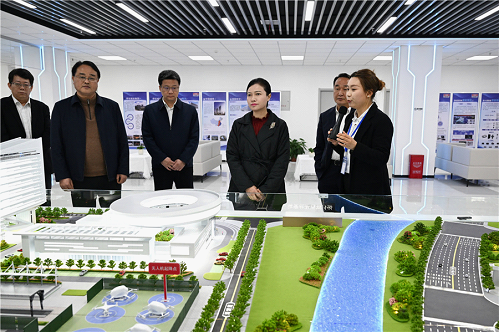
On the afternoon of March 19, Wei Zhaohui inspects low-altitude economy demonstration projects. In the picture, Wei Zhaohui learns in detail about the strategic planning and layout of the low-altitude industry's "One Center, One Base, One Cluster" development strategy, as well as the construction progress of the "Low-Altitude + AI" platform, at the Huaihua Low-Altitude Service Center. Photo by Wu Tao/Huaihua Daily
On the afternoon of March 19, while inspecting the "Low-Altitude + AI" demonstration project — a pilot initiative undertaken by the Huaihua Urban Development Group, Wei Zhaohui, Deputy Secretary of the Municipal Party Committee and Mayor of Huaihua, emphasized the need to seize the strategic opportunities presented by the development of the low-altitude economy. She urged that the low-altitude economy be developed in a manner tailored to local conditions, accelerating the cultivation of "new quality productive forces" to boost momentum and empower high-quality development. Lin Hua, Secretary-General of the Municipal Government, also participated in the inspection.
Upon arriving at the Huaihua Low-Altitude Service Center, Wei Zhaohui gained a detailed understanding of the strategic planning and layout for the low-altitude industry's "One Center, One Base, One Cluster" development strategy, as well as the progress made in constructing the "Low-Altitude + AI" platform. She also observed on-site demonstrations of various application scenarios and the operational status of the Hunan Province Low-Altitude Flight Service System.
Wei Zhaohui pointed out that the low-altitude economy is a future-oriented industry with vast potential. She stressed that the industrial layout must be planned to higher standards — anchored in Hunan while radiating outward to the Central and Southwest China regions — with the aim of becoming a pioneer and leader in the development of the low-altitude economy. She called for active efforts to formulate industry and group standards, promoting the piloting and subsequent external dissemination of standards related to low-altitude flight and intelligent control within Huaihua, thereby striving to enhance the industry's influence and standing. She urged a deepening of application scenarios, aiming to achieve breakthroughs in fields such as urban governance, emergency management, traffic safety, cultural and tourism promotion, and mine shaft supervision, thereby integrating the low-altitude economy into both urban governance and industrial development. Furthermore, she emphasized the need to strengthen industrial agglomeration by actively attracting upstream and downstream supporting enterprises to achieve a presence in the city, while simultaneously accelerating the cultivation and expansion of local market entities in the low-altitude economy sector. Finally, she called for innovation in business models, advocating for a steadfast adherence to market-oriented transformation pathways to ensure the sustainable operation of these projects. Efforts to promote and publicize low-altitude application scenarios must be intensified, fully leveraging various media platforms to showcase these scenarios through multiple channels and forms, thereby enhancing public awareness and boosting their application rate.
(Translated by Le Guobin)