
In the early morning by the Wushui River, the container yard of Huaihua International Land Port is surrounded by greenery. Laden with bamboo, timber, fresh produce, and other eco-friendly specialties, trains slowly roll out along the New Western Land-Sea Corridor, heading toward ASEAN countries.
As a key pilot zone for one of China's first—and Hunan Province’s only—ecological product value realization mechanism pilot cities, the Huaihua International Land Port Economic Development Zone has, in recent years, firmly pursued the guiding principle of “ecological priority and green opening-up.” By building on corridor connectivity, enhancing operational efficiency, and strengthening infrastructure, it has forged a new path where ecological protection and open development reinforce each other. This approach enables the region’s lucid waters and lush mountains to reach global markets through international corridors, while open development in turn nurtures its ecological foundations.
Weaving Lines into Networks, Connecting Rivers to Seas
Every morning, bamboo products from Jingzhou and Xinhuang arrive at Huaihua via short-haul trucking, while vegetables and flowers from Yunnan are distributed through the land port to central provinces and cities. Such scenes have now become a daily routine at Huaihua International Land Port. This integrated chain of "road-based cargo consolidation + rail trunk transport + overseas warehouse distribution" is steadily channeling ecological products from deep within the mountains out through the "mountain gate" to broader markets.
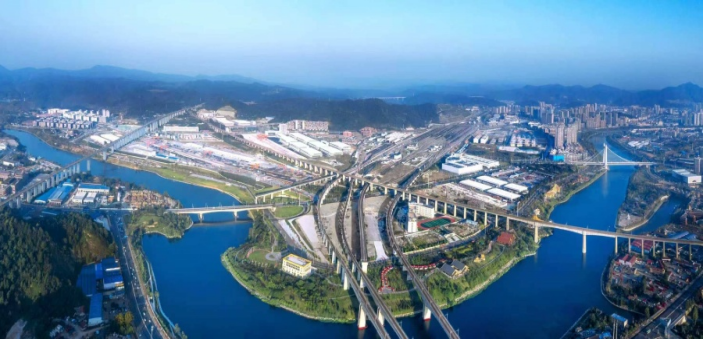
<Caption> Huaihua International Land Port Economic Development Zone
To date, Huaihua International Land Port has opened seven major international logistics corridors and 216 transportation routes, with its service network covering 238 ports across 72 countries and regions. It was among the first in central China to launch two-way cold-chain train services on the China-Laos and China-Vietnam routes. Three cold-chain lines—"Vientiane–Kunming–Huaihua," "Ho Chi Minh City–Pingxiang–Huaihua," and "Yantian Port/Qinzhou Port–Huaihua"—are now operating on a regular basis. A cold-chain logistics network radiating across the Wuling Mountain area is rapidly taking shape, becoming increasingly dense and interconnected.
Meanwhile, by partnering with industry leaders such as COSCO Shipping, Dekun, and Jiahui, the land port has enabled ecological products from deep inland to achieve a remarkable leap—reaching rivers and seas within 24 hours and arriving directly in ASEAN countries in just three days. It has also established 13 overseas warehouses in Laos, Vietnam, and other locations, initially building an end-to-end sales network abroad.
Lower Costs, Higher Efficiency — Smooth Flow of Goods
Ecological products cannot afford delays. For fruits, vegetables, and fresh flowers, the difference between arriving a day earlier or later can mean vastly different prices. To ensure that "freshness" outpaces "time," Huaihua International Land Port has rolled out a coordinated set of measures to reduce costs and boost efficiency.
By securing a 62% reduction in cold-chain freight rates from Kunming Railway Bureau, combined with a policy package of "train subsidies + platform concessions + railway discounts," the regional cold-chain logistics cost has dropped by 21% overall, while the price of imported ASEAN fruits has fallen by more than 20%. With strong support from customs authorities along the route, including Mengla, Pingxiang, and Qinzhou, a collaborative mechanism known as "Four Customs as One" has been put into operation. Trade facilitation measures such as "railway express clearance," "direct loading upon arrival," and "direct pickup at port" have made import and export customs clearance 8.8 hours and 0.1 hour faster than the national average, respectively.
On June 30 this year, the first scheduled train from Huaihua West to Qinzhou Port East was successfully launched and officially included in the national railway timetable, reducing the entire transit time to just 22 hours—a dramatic improvement from the previous three to four days. Mou Xiaofeng of Hunan Xianghuai Luggage Manufacturing Co., Ltd. remarked with emotion: "It used to take three days for our luggage exports to go through Nansha Port and Yantian Port. Now, they can enter the port the very next day, and our capital turnover has more than doubled!" Train after train, loaded with bamboo and wood products, agricultural and sideline goods from Huaihua and surrounding areas, is accelerating their journey overseas. What these trains are clearing is not just a logistics corridor, but a high-speed pathway for turning ecological value into tangible returns.
Since shipping its first trial batch through the land port in 2023, Hunan Rongjing Bamboo Industry Development Co., Ltd. has now stabilized at dozens of standard containers per month. Ma Jin, the company's head, said: "With the scheduled train service, our bamboo product transit time has been cut from three or four days down to 22 hours. Huaihua's bamboo products now truly have a say in the international market."
Infrastructure as Foundation, Capabilities on the Rise
At the Smart Cold-Chain Digital Logistics Center of Huaihua International Land Port, a single intelligent cold storage facility with a volume of 240,000 cubic meters operates around the clock. Inside the facility, temperature zones are precisely controlled, keeping fresh fruits, vegetables, and frozen products in their optimal conditions.
"A cold storage facility is not just a 'giant refrigerator'—it is an accelerator that preserves the freshness of ecological products," explained a staff member on site. Thanks to precise temperature control and smart management, specialty agricultural products from the Wuling Mountain area maintain their freshness throughout the entire process—from harvest to packaging, from warehousing to departure from the port—significantly reducing spoilage.
Not far away, the newly launched Multimodal Transport Center is equally bustling. Spanning 200,000 square meters, it integrates command and dispatch, customs inspection, cross-border e-commerce, and cold-chain warehousing under one roof. Seventy percent of southbound cargo along the New Western Land-Sea Corridor is efficiently transferred here, cutting logistics costs by over 15% and boosting cargo turnover efficiency by two to three times.
With 500,000 square meters of warehousing space and 420,000 square meters of factory floor area—stretching from production sites to ports, from inland regions to overseas markets—Huaihua International Land Port's hardware foundation is steadily being strengthened. Leveraging facilities such as Land Port No. 1, Guajiajia, and the ASEAN Exhibition and Sales Center, a comprehensive commercial hub integrating brand marketing, livestream e-commerce, and imported goods exhibition and sales is beginning to take shape.
The effort goes further still. The "AI Land Port" initiative is advancing in parallel, with blockchain and IoT enabling end-to-end cold-chain visibility. Take bananas shipped from Laos: from harvest to Chinese store shelves, temperature, humidity and location can be tracked in real time. Powered by technology, the natural quality of goods born of lucid waters and lush mountains is being turned into real competitiveness in global markets.
Turning Ecology into Value, Going Global Through the Port
When the corridor flows, mountain goods thrive. A set of figures tells the story of how the land port and ecological resources have benefited each other:
In 2025, Huaihua International Land Port handled 3,708 TEUs of cold-chain container shipments—a 17-fold increase year-on-year, ranking first among all inland ports in China in terms of shipping volume. That same year, it exported 442 TEUs of bamboo and wood products, up 57.86% year-on-year.
In the first half of 2026 alone, the port exported 240 TEUs of bamboo and wood products worth 27.14 million yuan, imported 160 TEUs of ASEAN fruits worth 6.5 million yuan, and dispatched 1,124 TEUs of Yunnan vegetables and flowers valued at 43.71 million yuan. Once hidden deep in the mountains, the ecological products of the Wuling Mountain area are now traveling southward along the railway tracks and crossing oceans to reach global markets.
Since the launch of regular point-to-point train services between Huaihua and Qinzhou Port, goods from central China have been rapidly consolidated in Huaihua, turning the vision of "reaching rivers and seas within 30 hours, arriving in ASEAN within three days" into reality. Bananas and longans from Laos now travel from their origin to Huaihua in just 2.5 days, down from four days; bamboo products and luggage from Huaihua can reach ASEAN markets from the workshop in no more than three days.
The construction of the land port is not the antithesis of ecological protection—it is a platform where the "Two Mountains" transformation takes place. Huaihua International Land Port will continue to pursue a mutually reinforcing approach of "protecting ecology through openness, and promoting openness through ecology," achieving both high-quality economic development and a high-quality ecological environment. In doing so, it aims to provide a replicable and scalable "Huaihua Model" for realizing the value of ecological products nationwide.
By the busy banks of the Wushui River, another train is being loaded. The scent of bamboo and wood, the sweetness of fresh fruits and vegetables, the fragrance of flowers—these "flavors of ecology" from deep within the mountains are about to travel southward along the railway tracks, telling Huaihua's "Two Mountains" story to the world.
(Translated by Feng Tao)