
On July 8, Mao Weiming, deputy secretary of the provincial Party Committee and governor, came to Xinhuang Dong Autonomous County for an investigation. He stressed that it is of necessity to follow the guiding principles in General Secretary Xi Jinping’s important remarks on the work relating to “agriculture, rural areas and rural people”, to highlight the features in the work, promote the integration of “agriculture, culture and tourism” and strive to draw a new beautiful picture about the revitalization of rural areas with prosperous agriculture, beautiful rural areas, and rich farmers.
Qu Hai, secretary general of the provincial government, attended the investigation.
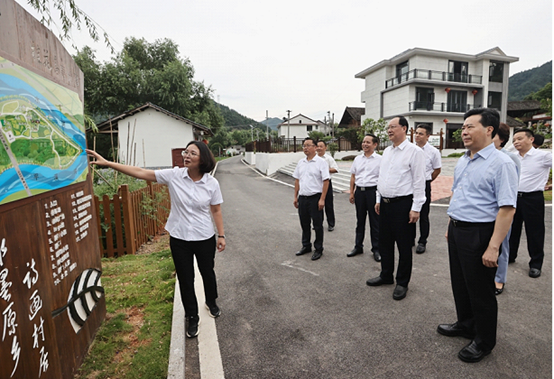
On July 8, Mao Weiming, deputy secretary of the provincial party committee and governor, investigated the work of rural revitalization in Jiangkou Village, Xinhuang Dong Autonomous County.
Mao Weiming and his entourage first came to Jiangkou Village, Bozhou Town, a key village for poverty alleviation in rural tourism. Walking into the village, you will find that the mountains beyond are lush, Wushui River is winding and the bucolic farmhouses are clean and tidy, attracting tourists from around. Learning that this place has become a well-known “online celebrity sign-in point”, Mao Weiming said that it is necessity to highlight the characteristics of local resources, continue to improve the living environment in rural areas, and constantly enrich new types of business like farming experience, tourism, and leisure vacations. And we will improve the level of service, promote the integration of agriculture and tourism, and let more people benefit from tourism, making their lives more and more prosperous.
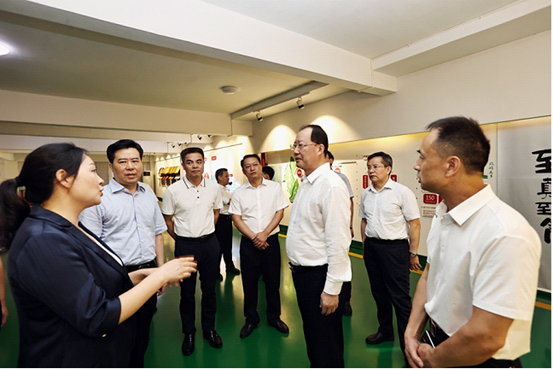
Mao Weiming investigated in Laocai Food Co., Ltd.
Xinhuang Laocai Food Co., Ltd. is a leading enterprise in agricultural industrialization at the provincial level, which integrates beef cattle breeding, processing and marketing. In recent years, more than 4,830 poor households have shaken off povertyby means of cooperatives. Mao Weiming and his entourage went into the breeding and processing workshop to inspect the operation and the development of the enterprise. He stressed the necessity to give better play to the role of leading enterprises in linking agriculture with farmers, to strengthen and upgrade the enterprise, stick to the bottom line of food safety, and constantly improve the added value and the influence of the products, thus continuing to bolster the status of “Xinhuang Yellow Cattle” to drive more people to increase their income and become rich.
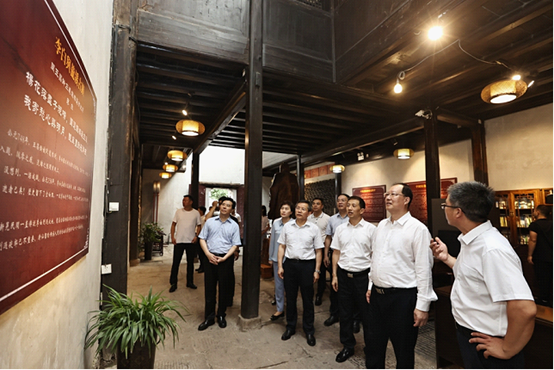
Mao Weiming investigated the integration of culture and tourism in Longxi ancient town.
Longxi, an ancient town on the banks of Wushui River, has been prosperous since the end of Ming Dynasty and the beginning of Qing Dynasty. There are more than 200 ancient buildings in the ancient town, with orderly ways and exquisite craftsmanship. Walking along the bluestone street, Mao Weiming learned about the protection and development of local tourism resources, and praised the ancient town for “taking into account national culture and the charm of the times”. He stressed that it is necessity to persist in developing in the course of protection and protection in the course of development, fully tap traditional culture and local customs, and actively develop characteristic industries of “culture + tourism”, so that traditional villages can retain rural affection, farmers can keep alive the local customs and feel homesick.
In the course of investigation, Mao Weiming stressed the need to resolutely adhere to the bottom line of not returning to poverty in a largescale, to keep a close eye on key groups such as marginal poverty-prone households and households with sudden and serious difficulties, improve the data-sharing mechanism of such departments as rural revitalization, civil affairs, Human Resources and Social Security and others, improve dynamic monitoring and development-oriented assistance, and take more measures to promote stable employment of the labor force, making the foundation for poverty alleviation more solid and the results more sustainable. It is necessary to speed up the construction of modern rural industrial system. We should deeply tap the endowment of characteristic resources, do a good job in developing and promoting“local products”, enhance the operation in an appropriate scale, promote the deep integration of primary, secondary and tertiary industries, and let agriculture, culture and tourism complement each other. We will continue to develop new functions of agricultural industry and new ecological values in rural areas. We should push forward rural construction in a down-to-earth manner. Aiming at the goal of “letting countrysides basically enjoy modern living conditions”, we should strive to make good use of the experience from Zhejiang’s “ten million projects”, formulate a unified practical village plan and popularize the plan in the rural areas, make an overall planning to lead the layout of rural infrastructure and public services, and retain rural customs and styles. It is necessity to continue to improve the capacity for rural governance. We should give full play to the leading role of grass-roots Party organizations, follow gridding management, digital empowerment, and fine services, and comprehensively enhance the efficiency of rural governance; we must attach equal importance to rural shaping and soul casting, and continue to cultivate civilized rural customs, good family customs, and simple folk customs, coruscating the new atmosphere of rural civilization.
(Translated by Yang Sigui)