
On the early morning of November 30, Tianwen Island was shrouded in mist. Twenty-nine "Tianwen lanterns," each inscribed with celebrated lines from the poem Tianwen (Questions to Heaven), were arrayed along Tianwen avenue. At the island's heart, a 14.15-meter-tall statue of Qu Yuan stood gazing upward, a scroll in hand as if in recitation, sketching a poetic tableau where a millennia-old Chu Ci literary heritage converges with modern cultural tourism.
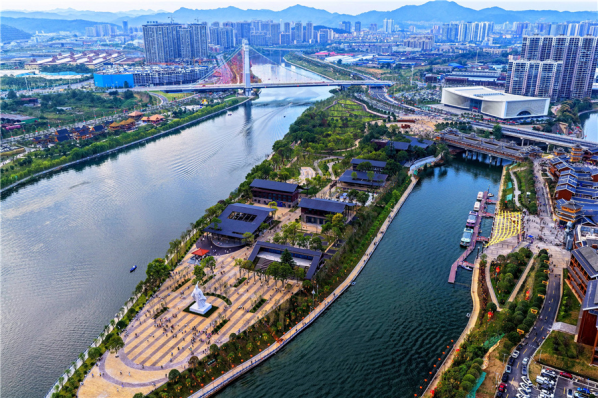
Site of Tianwen Photo by Pan Yu, Huaihua Daily
As the mist gradually dispersed, an intangible cultural heritage exhibition hall named "Mountain Market" came into view. Standing proudly before its main entrance was a painted dragon boat—crafted using Huaihua's intangible heritage technique of copper-caulked "Swallow-Tail Dragon Boat" making. With its "crocodile head, python body, and flying swallow tail" design, the vessel appeared poised to surge through the waves.
The dragon boat serves as a vessel for carrying forward Qu Yuan's patriotic spirit in Huaihua. During his exile along the Yuan River basin, Qu Yuan witnessed the spectacle of dragon boat racing among the local people and penned heroic verses such as "I ride a flying dragon northward bound" and "Upon a dragon boat, I ride the thunder." In his honor, the local community later developed the copper-caulked "Swallow-Tail Dragon Boat" making technique, using dragon boat racing as a way to commemorate him.
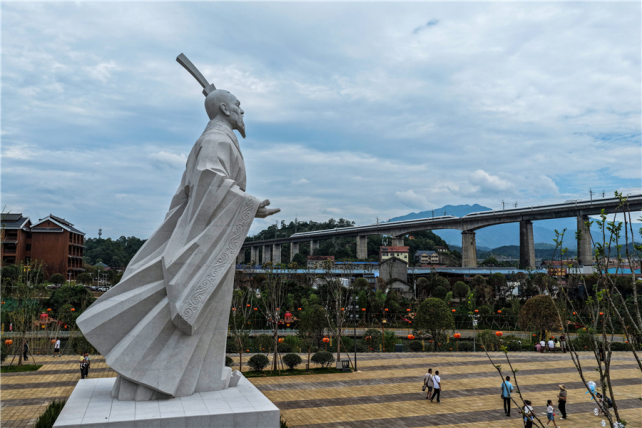
Statue of Qu Yuan Photo by Pan Yu, Huaihua Daily
"'Mountain Market' is now open!" A call from a man dressed in ethnic minority attire broke the quiet of the island.
Centuries-old intangible cultural heritage such as Dong brocade and Hua Yao cross-stitch dazzled visitors upon their debut, drawing crowds of admirers to the island. As footsteps echoed along the stone-paved paths of Tianwen Island, the rhythmic taps seemed to compose a gentle melody.
The "Mountain Market" is home to over 100 representative intangible cultural heritage projects from across Huaihua. Wandering through it feels like stepping into a vast cultural scroll unfurling through time.
In the Dong brocade weaving display area, large panels of brocade in hues of indigo, gold, and sapphire hang from the vaulted ceiling, evoking the majestic force of a waterfall — "as if a silver river had plunged from the sky." Where sunlight pierces the fabric, it projects an ever-shifting tapestry of light and shadow onto the ground. Meanwhile, overhead, diaphanous curtains inscribed with lines from Qu Yuan's Chu Ci verses infuse the marketplace with a refined, ancient charm.
Seated before her loom, Wu Nianji—a provincial-level representative inheritor of Dong brocade weaving—guides the shuttle rhythmically back and forth with a soft, regular "clack-clack." "Weaving wide-format Dong brocade is no easy task," she notes. "At most, we can weave only thirty to forty centimeters a day. When woven with black and white cotton threads, it becomes 'plain brocade'—elegant and solemn. When colored threads are interwoven, it turns into 'colorful brocade,' whose patterns are created either through weaving or cross stitch techniques. Whether the motif is a '人' shaped pattern or a '万' shaped design, every stitch carries the history of the Dong people."
After listening to Wu's explanation, a tourist called Li Yi from Guangdong marveled: "The warp-and-weft interlace is so intricate—just looking at it makes me appreciate how demanding this craft is!"
The haute couture section at the center of the market is a tangible expression of Dong brocade meeting modern fashion. One black gown, mysterious and elegant, features a deep V-neck that is both sharp and daring. Its sleeves, sheer as cicada wings, are accentuated with geometric Dong brocade motifs, enriching the texture. A yellow sleeveless dress incorporates the fabric's distinctive weave into its contemporary silhouette, while its skirt is embroidered with Dong brocade floral and avian patterns—symbols of auspiciousness and good fortune.
“This is even more stunning than top international brands!” said Zhong Xiuli, a fashion designer recently returned from abroad, as she photographed the gowns. “Having attended Paris Fashion Week many times, I know Huaihua's Dong brocade has long enjoyed international acclaim. Seeing such beautifully crafted garments incorporating its elements here is truly a delight.”
At the blue calico printing and dyeing demonstration, inheritor Zeng Zhaolong showed the process step by step. While the resist paste was air-drying, watching parents and children gathered around the dye vat to immerse the fabric in the indigo bath. Before their eyes, the cloth shifted from a grayish-green to a deep indigo blue. The children, faces full of wonder, chattered excitedly about "how the color works like magic," remarking that "the freshly made blue calico looks as lively and beautiful as the sea."
“Live demonstrations allow the audience to understand this traditional craft more intuitively and better promote the inheritance and dissemination of Huaihua's intangible cultural heritage,” Zeng Zhaolong told the reporter.
Just then, bursts of laughter came from the Chenzhou paper-cutting area. Local resident Yang Qianshan, who had just completed a piece titled “Tianwen Island,” excitedly held it up and said, “I never knew paper-cutting could do more than flowers and birds—it can even ‘contain’ the very landscapes of our Huaihua!”
"What distinguishes Yuanling Chenzhou paper-cutting from other regional styles," explained provincial-level ICH inheritor Xu Hengyang, "is its deep integration of the multi-ethnic cultural heritage of Huaihua—Han, Miao, Dong, and others. Its themes center on the landscapes of the Yuan River and local folk beliefs, accurately capturing the unique aesthetic sensibilities of Huaihua's people and the region's characteristic spirit of multi-ethnic coexistence. Many of our original works have even gained recognition abroad." Under his guidance, visitors eagerly tried their hand at cutting out silhouettes of Qu Yuan, dragon boats, and other motifs iconic to Huaihua.
The Jingzhou Carved Preserves experience area was filled with a delightful aroma. This national-level intangible cultural heritage, which originated in the Five Dynasties period and boasts a millennium of history, was once a royal tribute and is now a staple for hosting guests. This "palate-delighting heritage" offers a taste of Huaihua's traditional flavors and embodies the craftsmanship passed down through generations.
"Winter melon, pumpkin, and pomelo are all excellent ingredients. Through multiple steps—selecting, carving, and curing—Jingzhou carved preserves take their final form," explained the inheritor during the live demonstration. Gathered around the worktable, visitors eagerly tried their hand at the process, slicing, sculpting, and sketching patterns in one seamless flow.
“Coming to Tianwen Island, experiencing Qu Yuan's culture, and seeing so many intangible heritage skills—it’s truly eye-opening,” exclaimed Rao Hongmei, a tourist from Guangzhou, in the Hua Yao cross-stitch exhibition area. Once primarily used to decorate traditional Hua Yao clothing, the craft has now been integrated into daily life, appearing subtly on belts, cotton socks, handbags, and earrings.
Preserving heritage while embracing trends breathes new vitality into old memories. At the "Mountain Market," visitors can not only see, touch, and taste—they can also, quite naturally, shop to their hearts' content.
In the "Mountain Zoo" section, a row of plush animal dolls—each imprinted with intangible cultural heritage motifs—lined the shelves, brimming with cultural charm. "Our bestselling item is the snow-white 'AI Flower Bunny' doll," shop assistant Yang Qiu told the reporter. "Its ears are embroidered with the classic ‘卍’-pattern from Dong brocade, and visitors can even chat with it in real-time using its smart voice feature."
Meanwhile, the "Mountain Cultural Products" area displayed a dazzling array of creative goods: cloth bags printed with Chenzhou paper-cutting designs, home cushions incorporating Dong brocade patterns, tablecloths sewn from blue calico… Each ingeniously designed, personality-rich product seamlessly bridges local traditional motifs with contemporary living, winning fervent admiration from young consumers and becoming a tangible "Memory of Huaihua" to take home.
"Reaching the market is a vital pathway for promoting and developing intangible cultural heritage; their combination sparks real innovation," said Wang Jiarui, head of the "Mountain Market." "We are committed to building a bridge that connects heritage bearers with the marketplace, creating a 'living museum of ethnic culture.' On one end are the master artisans with their exquisite skills, and on the other are consumers from all over. Today, through online sales platforms, these products—carrying both craftsmanship and the essence of Huaihua's intangible heritage—are reaching an ever-wider audience."
【Reporter's Notes】
Sowing the Seeds of Intangible Heritage
At the "Mountain Market," there is no cold barrier—everything carries warmth. The rhythmic "clack-clack" of Dong brocade weaving, the joyful laughter of visitors trying paper-cutting, the wonder of children gathered around blue calico dye vats, the youthful appeal of trendy toys in the "Mountain Zoo"... Ancient intangible heritage skills have been transformed into something tangible, experiential, and takeaway. These scenes reveal how intangible heritage lives within cultural tourism—how "heritage-themed travel" is infused with cultural depth.
Intangible cultural heritage is not a static cultural symbol, but a living cultural organism deeply rooted in practice and embedded in daily life. By adopting diverse forms of presentation, the "Mountain Market" creates contextual and immersive cultural experiences, bringing heritage into scenic areas. This approach infuses it with more vibrancy and visibility, captivates visitors, resonates deeply, and ultimately sows the seeds for its continued life.
Intangible heritage is priceless, and its safeguarding demands thoughtful approaches. Rooted in the "Five Streams Culture" and inspired by the romantic spirit of Chu Ci poetry, the "Mountain Market" skillfully blends distinctive heritage crafts—such as Dong brocade weaving and Chenzhou paper-cutting—with contemporary living. It creates a cultural space that integrates immersive experience, aesthetic engagement, and mindful consumption. Through this "living mode of engagement," intangible cultural heritage gains enduring vitality and radiates captivating charm.
(Translated by Feng Tao)